
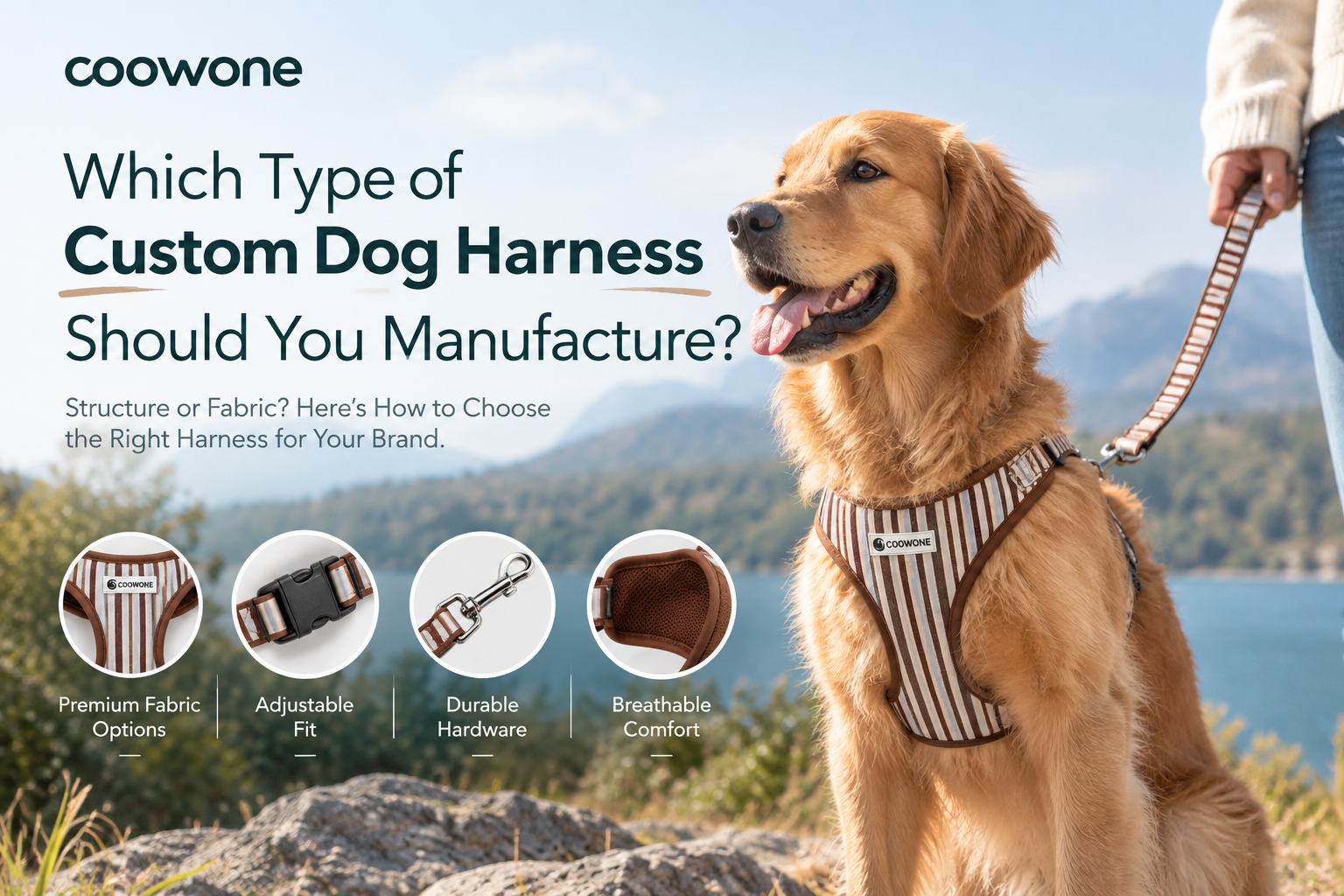
Ask most first-time brands what harness they want, and you get a fabric answer.
“We want a velvet harness.”
“We’re thinking about neoprene.”
Fabric is the visible decision, so it is the one people make first. But it answers the question “what should this look like?” and not the one that actually drives your reviews, your return rate and your reorders: “what should this do?”
Those are two separate decisions. A harness has a structure — where the leash attaches, how the dog gets into it, how the chest panel is cut — and it has a fabric. You can put any fabric on almost any structure, which means eleven off-the-shelf SKUs are really just a handful of structures wearing seven different materials.
Get the structure wrong and no fabric will save it. This article walks through both axes, then shows how to combine them.
Decision 1: Structure
Structure has three independent sub-decisions. Most buyers pick one and never realise the other two exist.
1a. Where does the leash attach?
This is the single most consequential choice in the whole product, and the one most listings get wrong.
Back-clip (ring between the shoulder blades). Comfortable, keeps all pressure off the neck, easy to fit. It is also — and this surprises people — the geometry that encourages pulling. That is not marketing opinion; it is the shape you would deliberately build if you wanted an animal to pull into it, which is exactly what sled harnesses are.
Measured evidence backs this up. Shih and colleagues, publishing in Frontiers in Veterinary Science in 2021, instrumented the leashes of 52 shelter dogs walking toward food and compared a back-connection chest harness against a neck collar, with each dog acting as its own control:[1]
| Measurement | Back-clip harness | Neck collar |
|---|---|---|
| Maximum leash tension | 16.87 N | 6.97 N |
| Mean leash tension | 5.3 N | 3.14 N |
| Proportion of time spent pulling | 0.67 | 0.35 |
Dogs pulled roughly twice as hard and nearly twice as often on the harness. The mechanism is not mysterious — a strap across the shoulders gives the dog something comfortable to lean against, and comfort is precisely what removes the feedback.
The takeaway for your line: if you want to sell a harness as “no-pull”, it needs a chest attachment point. A back-clip harness can be an excellent product — for calm walkers, small breeds, flat-faced breeds and dogs with tracheal sensitivity — but calling it no-pull misrepresents it and generates the one-star review that says “still pulls”.
Front-clip (ring at the sternum). The load lands ahead of the dog’s centre of mass and off the midline of the pull, so the dog cannot brace — it gets turned back toward the handler. No correction, no pressure on the neck. Johnson and Wynne, in PeerJ (2024), measured pull force across four equipment types in 23 shelter dogs and found the front-connection harness statistically indistinguishable from a front-range prong collar on that measure.[2]
Two honest caveats, because they will come up in your customer reviews whether you plan for them or not:
- It manages pulling; it does not train it. A dog that wears a front-clip harness for two years will still pull on a flat collar, because the equipment was doing the work. Say this on your product page and you will get fewer refund requests.
- It changes gait. A 2026 review by Ridgway reported that all harness types studied altered movement to some degree — this is not unique to front-clip designs, but it is real.[3] Fit matters enormously: keep the chest strap below the point of the shoulder.
Dual-clip (both rings). We recommend this as the default for most launch lines. It lets the customer use the chest ring while training and the back ring once the dog walks politely — one SKU covering two use cases, and one less reason to return it.
| Attachment | What it does | Build it for | Do not describe it as |
|---|---|---|---|
| Back-clip | Comfort, zero neck pressure | Calm walkers, small breeds, brachycephalic dogs, tracheal issues | “No-pull” |
| Front-clip | Redirects the pull, turns the dog | Dogs in training, strong pullers, reactive dogs needing steering | A replacement for training |
| Dual-clip | Both, switchable | Nearly every general-purpose line | — |
Figure 1 — Attachment geometry is a function, not a feature tier.
1b. How does the dog get into it?
Step-in. The dog places its front paws into two openings and you buckle over the back. Nothing passes over the head or ears, which makes it the right call for head-shy rescue dogs, dogs with ear sensitivities, and small breeds where owners struggle with overhead handling.
The trade-off is escape. A step-in relies on that single back buckle and on the dog pulling forward; a dog that spooks and reverses can slide out of the leg openings — especially narrow-headed breeds. If your customer base skews to escape artists, this is not your structure.
Overhead. Passes over the head, then buckles around the body. More secure against backing out, better for deep-chested breeds, and usually allows more independent adjustability at neck and chest. The cost is introductory training — some dogs need a slow, treat-led desensitisation before they will accept it.
| Step-in | Overhead | |
|---|---|---|
| Best for | Head-shy dogs, small breeds, rescue dogs | Escape artists, deep-chested breeds, dogs needing a front ring |
| Avoid when | The dog has a narrow head and a history of backing out | The dog panics at anything near the face |
| Key spec to get right | Even leg-opening placement, chest panel centring | Neck opening circumference and shoulder clearance |
Figure 2 — Entry method is a behavioural decision, not a convenience one.
1c. How is the chest panel cut?
Y-shape. Front straps form a Y with a vertical strap running between the front legs, resting on the breastbone and keeping the throat clear. This leaves the shoulder blade free to rotate, which is why it is the standard recommendation for active dogs, running and hiking.
H-shape. Front straps cross horizontally over the shoulders with no strap between the legs. Better for dogs with narrow spacing between the front legs, where a Y strap tends to rub.
Vest / wrap. Broader chest coverage on a padded panel. Distributes pressure over a wider surface, suits small breeds and long-coated dogs, reduces chafing — and runs warmer, which matters in hot climates.
Worth knowing before you write your copy: gait studies have found small movement changes in both Y-shaped and horizontal-strap designs. “Y-shape” is a sensible anatomical starting point, not a guarantee — fit does more work than the label.[3]
Decision 2: Fabric
Fabric drives your price point, your seasonality, and which decoration methods you can use. Here is the practical picture across the seven families that cover most of the market.
| Fabric | Character | Best for | Watch out for | Decoration that works |
|---|---|---|---|---|
| Neoprene | Soft, slightly springy, water-resistant | All-weather and water-dog lines, padded comfort builds | Thicker hand-feel; needs clean taping or binding at raw edges | Full sublimation print — takes colour brilliantly |
| PVC-coated webbing | Fully waterproof, wipe-clean, odour-resistant | Rainy-climate markets, muddy-dog positioning, bright colour stories | Odour control during production; stiffens in hard cold | Solid colour, screen print, moulded 3D logo |
| Corduroy | Ribbed, warm, retro-preppy | Autumn/winter drops, heritage aesthetics | Pile direction must run consistently across panels; abrasion at contact points | Woven label, TPU patch — prints poorly on rib texture |
| Tweed | Textured, tailored, unmistakably premium | Capsule collections, gift season, higher price tiers | Highest material cost; fraying needs clean finishing | Woven label or embroidery only — let the fabric be the design |
| Teddy / sherpa fleece | Very soft, high tactile appeal | Small breeds, winter comfort lines, photogenic listings | Shedding and pilling — insist on a rub test before bulk | Embroidered or TPU patch; avoid large print areas |
| Denim | Hard-wearing, gender-neutral, ages visibly | Streetwear collaborations, workwear aesthetics | Indigo crocking — colour transfer onto light fur and clothing. Confirm dye compliance with your factory before sampling | Contrast stitch, leather-look patch, embroidery |
| Velvet | Deep lustrous pile, reads expensive | Holiday collections, luxury positioning, evening-walk framing | Crushes under compression; needs careful packing and steaming on receipt | Foil stamp or embroidery; prints flatten the pile |
Figure 3 — Fabric selection matrix. Darker fabrics cost more per metre but support higher retail; textured fabrics usually preclude printing.
How to combine the two axes
Once you have one decision from each column, you have a spec. Some combinations are proven sellers; a few are traps.
| If your customer is… | Structure | Fabric | Why this pairing |
|---|---|---|---|
| A small-breed owner in a wet climate | Step-in, back-clip, vest | PVC-coated or neoprene | Easy on/off for a dog that hates overhead handling; dries in minutes |
| Training a strong young puller | Overhead, dual-clip, Y-shape | Neoprene (padded) | Front ring plus secure fit plus shoulder freedom under load |
| Buying a gift or seasonal item | Either, dual-clip | Velvet, tweed or teddy | Fabric carries the perceived value; structure stays safe and uncontroversial |
| Buying for a flat-faced breed | Vest or Y-shape, back-clip | Neoprene or teddy | Zero throat contact, soft against the airway |
| Style-led, walking in the city | Overhead, dual-clip | Corduroy, denim or tweed | Tailored fabrics need the cleaner silhouette of an overhead cut |
| Running, hiking, canicross | Y-shape, dedicated pull geometry | Lightweight nylon or neoprene | Maximum shoulder excursion; deliberately enables pulling |
Three pairings to avoid.
- Step-in + heavy/tailored fabric. Tweed and thick denim fight the fold-and-buckle motion and add bulk where a small dog least tolerates it. Use them on overhead cuts.
- Textured fabric + large printed artwork. Printing on corduroy rib, velvet pile or sherpa produces a muddy result. If the design is the product, choose neoprene and sublimate.
- Front-clip-only + no adjustments. Pull force lands off-centre, so an unadjustable harness rotates under load. Specify at least two adjustment points on any no-pull claim.
What to specify when you request a quotation
The most reliable predictor of a smooth first sample is how complete the brief is. Bring these seven answers and you will cut several rounds off development:
- Attachment: back-clip, front-clip or dual
- Entry: step-in or overhead
- Chest cut: Y, H or vest
- Fabric and weight (gsm where you have it)
- Decoration method per position — woven label, TPU patch, embroidery, sublimation, screen print
- Hardware: metal or acetal, plating colour, D-ring type, buckle break strength
- Size range and target chest-girth measurements rather than breed names
Item 7 catches more first-time brands than anything else. Breeds vary enormously inside a size band — a 10 lb Chihuahua and a 10 lb French Bulldog differ by several centimetres in chest girth, so always specify girth ranges, not breed labels.
FAQ
Do I need a front ring to call my harness “no-pull”?
Yes. The chest attachment is the entire mechanism: it redirects the dog’s forward momentum instead of letting it brace. A back-clip-only harness cannot deliver that, and the measurements bear it out — dogs pulled harder on a back-clip harness than on a plain collar in a 2021 instrumented study.[1] Calling a back-clip product no-pull invites exactly the review you do not want.
Which is better for resale — step-in or overhead?
Neither universally. Stock step-in if your customers skew to small breeds, rescue dogs or head-shy dogs. Stock overhead if they have escape artists or dogs that pull. If you can only carry one, overhead is the safer bet because it also accommodates a front ring.
Can I put any fabric on any structure?
Technically yes, practically no. Beverage-weight fabrics like tweed and thick denim fight the fold-and-buckle motion of a step-in, and heavily textured surfaces do not take print. Your factory will tell you quickly — ask before you finalise artwork, not after.
How much does fabric affect unit cost?
Materially. Tweed and leather-trimmed builds sit at the top of the range; printed polyester and nylon sit at the bottom, with neoprene, corduroy, denim and PVC-coated webbing in between. But fabric is also your main lever on retail price, so the cheapest option is rarely the most profitable one. Request a stepped quote comparing two fabrics rather than assuming.
Should I launch with one structure or several?
One structure across several fabrics, for your first drop. Your packaging, photography and size copy all stay consistent, your size curve gets validated once, and customers perceive a coherent collection rather than a scattered catalogue. Add a second structure once you know which sizes and prints actually sell.
What causes the most harness returns?
Fit, not quality. Specifically: harnesses sized by weight instead of chest girth, insufficient adjustment points, and chest straps that sit above the point of the shoulder. Publish girth measurements rather than breed guesses and you will cut returns more than any material upgrade can.
Ready to spec your first harness line?
Structure first, fabric second — that order will save you a sample round and a good number of returns.
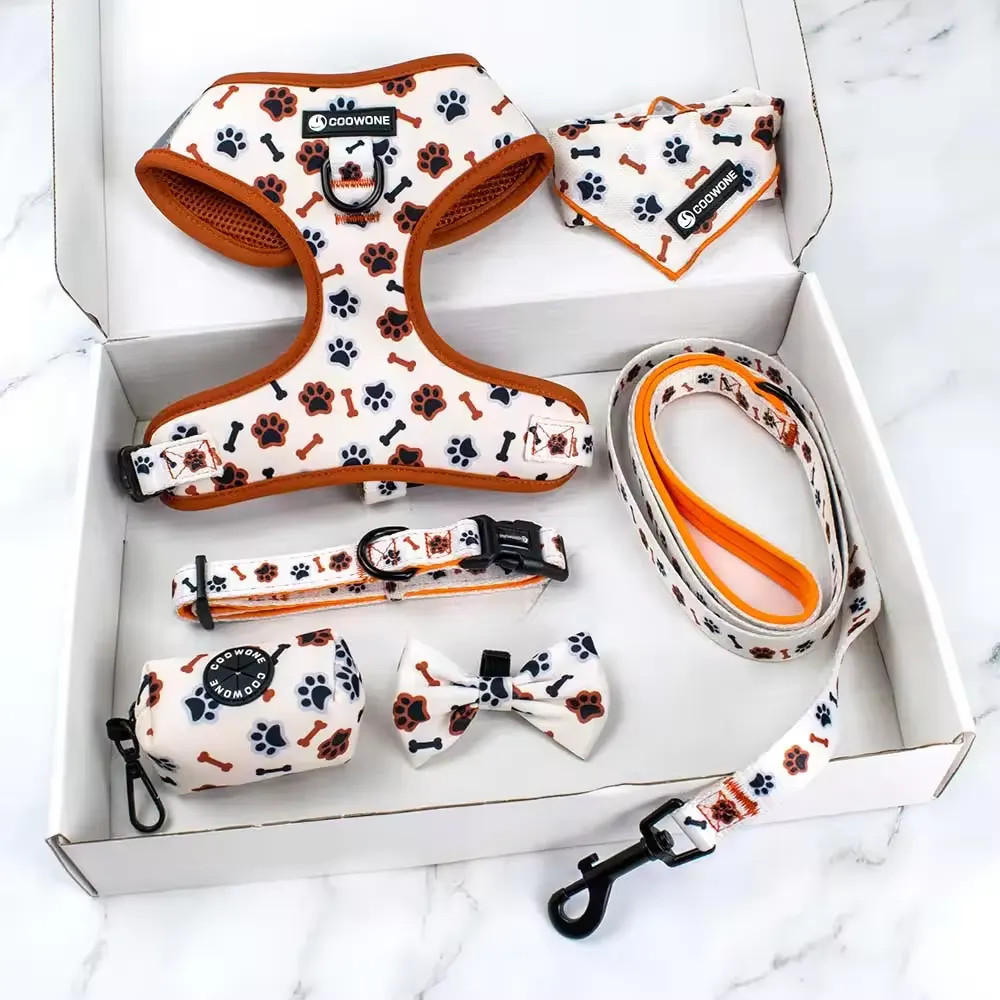
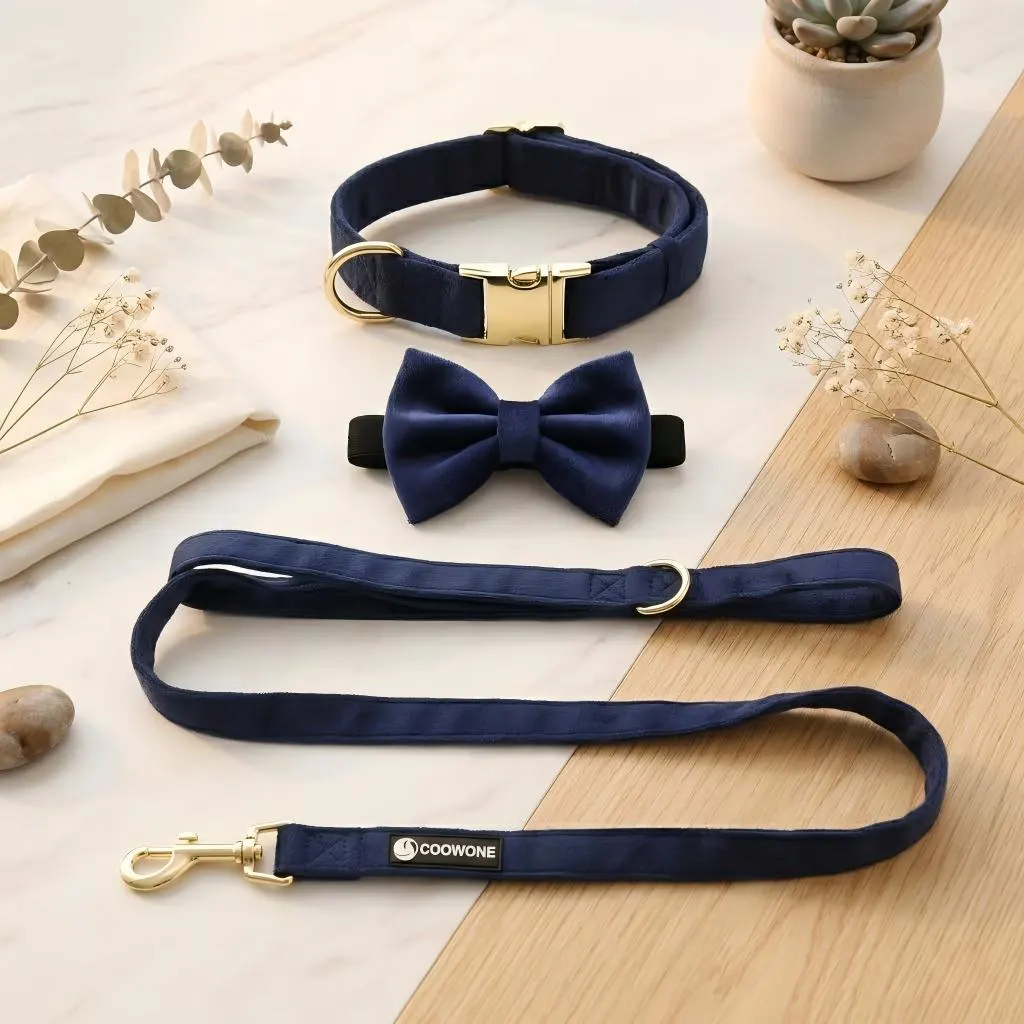
COOWONE manufactures all eleven harness constructions, from step-in and overhead to Y-shape and vest, across neoprene, PVC-coated, corduroy, tweed, teddy, denim and velvet — with sublimation, screen print,embroidery, woven labels and TPU patch options, plus matching collars, leashes and walking bags built from the same artwork.
References
- Shih, H.-Y., et al. (2021), Comparison of Leash Tension When Walking Dogs Using Different Collars and Harnesses, Frontiers in Veterinary Science 8:735680. Instrumented leash-tension study across 52 shelter dogs, each acting as its own control. https://doi.org/10.3389/fvets.2021.735680 — Note: shelter-dog sample, motivated-walk conditions. The authors’ own caution about generalising to ordinary pet walks applies.
- Johnson, A. C., & Wynne, C. D. L. (2024), Comparing efficacy in reducing pulling and welfare impacts of four types of leash walking equipment, PeerJ 12:e18131. https://doi.org/10.7287/peerj.preprints.18131
- Ridgway, M. (2026), Health implications of dog-worn equipment: a review of known and alleged physical risks, Frontiers in Veterinary Science 13:1711781. Review reporting that all harness types studied altered gait to some degree.