
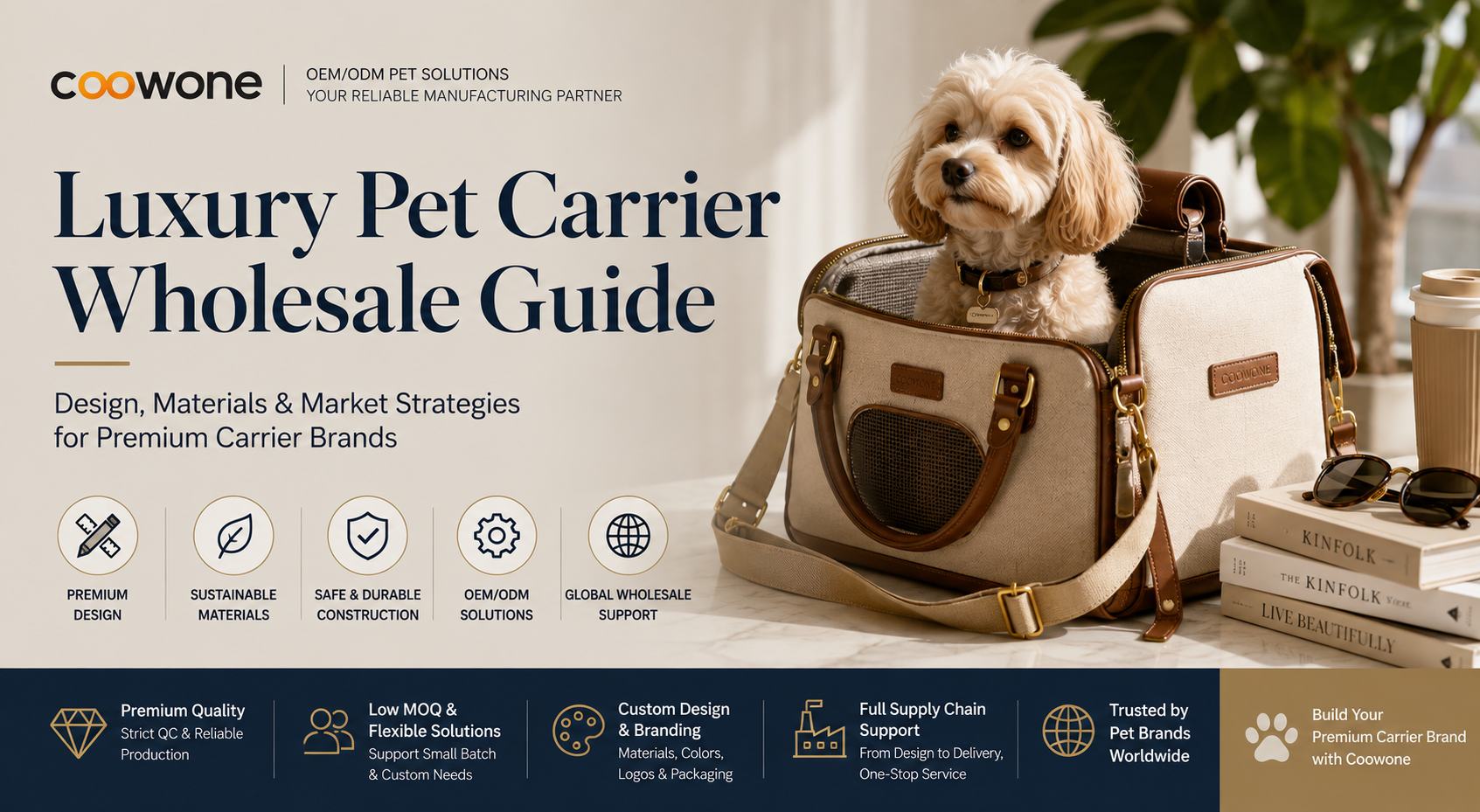
La premiumisation des accessoires pour animaux de compagnie a atteint un point critique. Dans les principaux marchés métropolitains d’Amérique du Nord, Europe, et Asie de l'Est, pet carriers are no longer viewed as utilitarian transport vessels but as fashion accessories that signal lifestyle identity and brand allegiance. The global luxury pet market exceeded $6 billion in 2025, with carrier bags representing the fastest-growing subcategory as urban-dwelling professionals integrate their pets into social, voyage, and work contexts where appearance matters. For wholesale importers and private-label brands, the luxury carrier segment offers margin profiles that mass-market products cannot approach. Produits d'extérieur Cie. de Dongguan Coowone., Ltée. produces premium-tier carrier collections for boutique labels and international distributors, and this analysis examines the design codes, material specifications, and market positioning strategies that define successful luxury pet carrier wholesaling.
Defining Luxury in the Pet Carrier Context
Luxury in pet accessories diverges from traditional luxury goods framing. While leather handbags and Swiss watches derive value from heritage, exclusivity, and artisan mythology, pet carrier luxury is constructed around distinct pillars:
Authenticité matérielle
Premium carriers use genuine materials rather than synthetic simulations. Cuir pleine fleur, waxed canvas, Italian wool felt, and brushed aluminum hardware communicate substance that PU leather and ABS plastic cannot replicate. The tactile experience of opening a carrier lined with lamb’s wool or watching patina develop on vegetable-tanned leather over months of use creates emotional attachment that justifies premium pricing.
Architectural Form
Luxury carriers reference high-fashion luggage and accessory silhouettes. Structured bases derived from luxury tote engineering, rolled leather handles adapted from briefcase design, and signature hardware closures that echo clasp mechanisms from heritage handbag brands signal intentional design rather than generic pet-product styling.
Functional Refinement
Premium positioning does not excuse functional compromise. Luxury carriers must perform flawlessly: ventilation adequate for multi-hour flights, structural integrity that protects the occupant, and ergonomics that distribute weight comfortably for the human carrier. The luxury consumer will not tolerate a $400 bag with broken zippers or inadequate airflow.
Scarcity and Story
Limited production runs, designer collaborations, and artisan construction narratives create perceived exclusivity. A carrier produced in batches of 500 by a team of specialized leatherworkers supports a fundamentally different value proposition than an injection-molded unit produced in quantities of 50,000.
Material Trends Driving Premium Positioning
Sustainable Luxury Materials
The convergence of sustainability and luxury is particularly pronounced in pet accessories. affluent consumers increasingly reject conspicuous consumption in favor of conscious consumption. Premium carriers now incorporate:
- Apple leather (derived from apple waste recovered from juice processing) that offers leather-like performance without bovine agriculture.
- Piñatex (pineapple leaf fiber composite) providing a textured, organic surface with lower environmental impact than animal leather.
- Recycled cashmere linings repurposed from luxury garment production remnants.
- Cork fabric harvested without tree felling, offering natural water resistance and antimicrobial properties.
These materials carry narrative value that synthetic alternatives cannot match, supporting marketing content that emphasizes environmental responsibility alongside aesthetic refinement.
Hardware as Jewelry
Luxury hardware transcends function. Solid brass fittings that develop verdigris patina, magnetic closures with satisfying mechanical action, and hand-polished aluminum ventilation grilles transform mechanical components into design statements. Premium carriers specify investment-casting hardware rather than die-cast zinc, because the surface finish and structural density communicate quality before the customer reads a label.
Textile Innovation
Beyond leather alternatives, luxury carriers exploit advanced textile engineering. Japanese nylon ripstop with DWR coating provides water resistance without the synthetic sheen of standard polyester. Merino wool-blend fabrics regulate temperature and resist odor, addressing the reality that carriers spend hours in urban environments. Linen-cotton composites offer breathable elegance suited to warm-climate metropolitan aesthetics.
Design Codes of Premium Carriers
Minimalist Branding
Luxury carriers reject the oversized logos and visible branding typical of mass-market products. Brand marks are embossed, debossed, or subtly metal-stamped in locations visible only to the discerning observer. The product speaks through material and form rather than through graphic declaration.
Architectural Structure
Rigid or semi-rigid bases derived from luxury luggage engineering prevent the carrier from sagging when carried. Vertical walls maintain shape without the occupant, ensuring the bag retains its silhouette on a restaurant chair or airline floor. Structured bases also protect the animal by distributing impact forces and preventing crushing.
Interior Climate Engineering
Premium carriers invest in the internal environment. Removable, machine-washable beds in memory foam or orthopedic gel provide comfort for extended travel. Ventilation is integrated into the design language rather than applied as mesh windows—perforated leather panels, slatted aluminum inserts, or grommet arrays that resemble high-end luggage hardware rather than pet-product functionalism.
Color Theory
Mass-market carriers deploy primary colors and high-contrast patterns. Luxury carriers favor earth tones, muted metallics, and achromatic palettes that coordinate with professional wardrobes. The four foundational colorways in premium carrier collections are typically: espresso brown, charcoal, marine, and cream—with seasonal limited editions in olive, burgundy, or slate.
Consumer Segments and Purchase Triggers
Urban Professional Women
The core demographic for luxury pet carriers is women aged 28–42 in metropolitan areas with household incomes exceeding $100,000. They view the carrier as an extension of their personal style and are influenced by lifestyle content on Instagram and Pinterest. Purchase triggers include pet-friendly workplace policies, urban apartment restrictions that require carrier-based building entry, and social occasions where the pet accompanies the owner to brunch, shopping, or travel.
Frequent-Flyer Pet Owners
Owners who travel with small dogs multiple times monthly require carriers that satisfy airline regulations while projecting sophistication at the destination. These buyers prioritize durability, TSA-friendly opening designs, and cabin-under-seat compatibility. They are less price-sensitive than typical consumers because the carrier represents a travel essential rather than a discretionary accessory.
Gift Buyers
Luxury pet carriers rank among the most requested pet-related gifts for significant life events—new puppy acquisitions, adoptions, or birthday celebrations for pet-obsessed recipients. Gift buyers favor immediately impressive presentation: rigid boxes, tissue paper, ribbon closures, and enclosed care booklets that elevate unboxing into an experience.
Celebrity and Influencer Markets
When high-follower pet Instagram accounts feature a luxury carrier, the associated brand experiences demand surges that can deplete inventory within days. Designing carriers that photograph well—clean lines, elegant material drape, and distinctive hardware—creates organic marketing potential that far exceeds paid advertising ROI.
Manufacturing and Quality Standards
Luxury carriers demand production capabilities that general pet-product factories rarely possess.
Stitching and Construction
Premium carriers require stitching standards borrowed from leather goods manufacturing. Saddle stitching by hand or precision machine creates seams that are both stronger and more visually refined than lockstitch alternatives. Edge finishing—burnishing leather edges, binding fabric edges with silk tape, or sealing coated canvas with heat—prevents fraying and creates polished visual closure.
Assurance qualité
Each luxury carrier should undergo inspection protocols exceeding standard consumer goods sampling. Every unit—not merely a statistical sample—should be checked for hardware operation, stitch consistency, material defects, and dimensional accuracy. The cost of individual inspection is absorbed within the premium margin structure. À Coowone, notre premium-tier production workflows implement 100% inspection on luxury lines before packaging.
Packaging as Part of the Product
Luxury unboxing is a designed experience. Outer packaging should be a rigid kraft or coated paper box that protects the carrier while conveying quality. Interior packaging includes branded tissue, dust bags for storage, care instruction booklets printed on heavy stock, and authenticity cards. The packaging cost may reach $4 à $8 per unit—absorbed by retail pricing that starts at $150 and extends past $400.
Margin Architecture of Luxury Carriers
Factory costs for luxury carriers scale dramatically with material and labor intensity:
- Entry luxury (premium faux leather, good hardware, refined design): $18–$28 factory cost, retailing at $79–$129.
- Mid-luxury (genuine leather or advanced textile, solid hardware, artisan details): $35–$55 factory cost, retailing at $149–$249.
- Ultra-luxury (full-grain Italian leather, investment-cast hardware, hand-finishing, limited production): $80–$150 factory cost, retailing at $350–$650.
Gross margins are structurally higher than mass-market carriers because the consumer perceives value through material quality and design story rather than through incremental manufacturing cost. UN $20 upgrade from faux leather to genuine leather adds $80 à $120 in perceived retail value.
Distribution and Channel Strategy
Luxury carriers do not perform optimally on Amazon or mass e-commerce. They require curated retail environments where brand storytelling, material handling, and lifestyle presentation support the price architecture.
Premium Pet Boutiques
Independent retailers in affluent neighborhoods provide the tactile experience and knowledgeable staff that justify luxury pricing. These stores typically operate on wholesale terms of 50% keystone markup.
Direct-to-Consumer Webstores
Brand-owned websites with editorial content, behind-the-scenes manufacturing features, and customer lifestyle photography build the brand narrative that third-party retail cannot replicate. The direct channel captures full retail margin while building proprietary customer data.
Veterinary and Grooming Salons
High-end service providers serving affluent clientele can generate significant accessory sales when the carrier aligns with the establishment’s aesthetic. Wholesale terms here typically include consignment arrangements rather than outright purchase.
Luxury Department Store Pet Shops
Curated pet sections within Nordstrom, Neiman Marcus, or their European equivalents reach fashion-conscious consumers already browsing accessories. Entry into these channels requires rigorous vendor audits and packaged-goods presentation standards.
Conclusion
The luxury pet carrier market rewards brands that understand luxury as a system of material truth, intention de conception, and narrative coherence rather than as a price point. By engineering carriers with genuine materials, architectural form, and refined packaging within a transparent production story, importers create products that justify premium retail positioning with authentic value rather than hollow markup.
For brands developing luxury carrier collections, Produits d'extérieur Cie. de Dongguan Coowone., Ltée. fournit premium manufacturing capabilities for sophisticated pet travel products. From material sourcing and hardware specification to bespoke packaging and quality assurance, we deliver accessoires pour animaux de compagnie personnalisés that meet the exacting standards of the luxury market. Contact our team to discuss your premium collection vision and production requirements.