
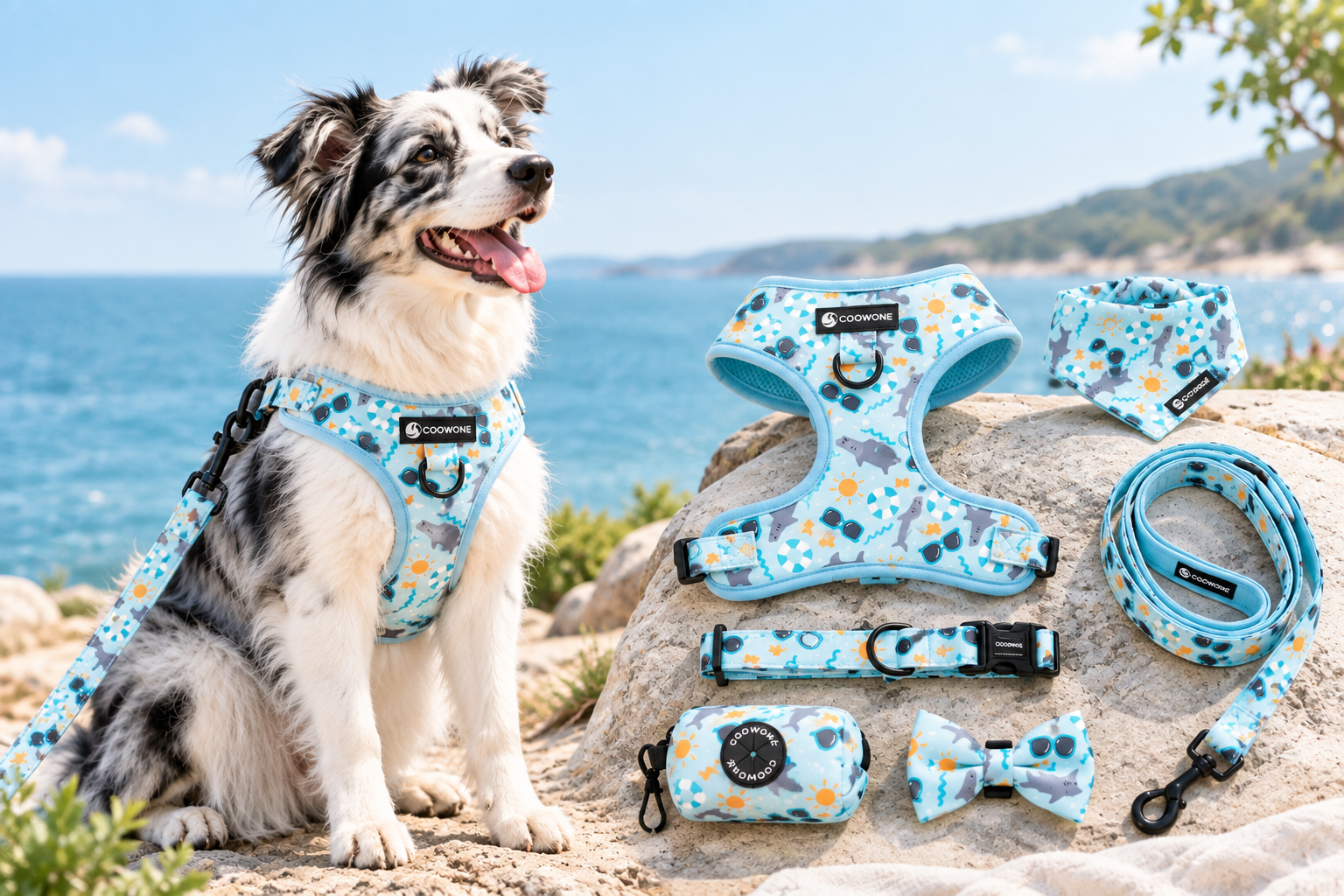
Si vous lancez une ligne de harnais pour chiens, the size range you offer will affect your return rate more than almost any other decision. Fit-related returns are the number one cause of margin erosion in this category — and most of them trace back to a size chart with too few increments or unclear measuring instructions.
Based on our production experience across 500+ brand partners, here’s what actually works — and what to avoid.
→ Get a custom harness quote in 24 hours
1. Why size range is a profit decision, not a design detail
A harness that doesn’t fit gets returned. Returns cost you the shipping, the restocking labor, and often the customer — because a bad fit feels like a product quality problem to the buyer, even when the harness itself is well made.
The numbers from our partner data:
- Brands offering five or more size increments with a clear measuring guide report over 25% fewer fit-related returns compared to brands offering three sizes
- Adding a QR-coded fitting instruction card in the packaging further reduces returns caused by user error (wearing the harness incorrectly rather than the size being wrong)
The math is straightforward: one extra size increment costs marginally more in inventory complexity, but saves multiples of that in avoided returns.
2. What size increments should you actually offer?
Four sizes (S/M/L/XL) is the common default, and it’s the main reason returns are high. Dogs vary far more in torso dimensions than in weight, and weight-based sizing charts are a frequent source of error.
Our recommended structure — five to six increments:
| Taille | Girth Range (cm) | Girth Range (in) | Typical Breeds |
| XS | 28–38 | 11–15 | Chihuahua, Yorkshire Terrier, poméranien |
| S | 36–48 | 14–19 | Shih Tzu, Maltese, Miniature Dachshund |
| M | 46–60 | 18–24 | Beagle, Cocker Spaniel, French Bulldog |
| L | 58–74 | 23–29 | Labrador, Golden Retriever, Border Collie |
| XL | 72–90 | 28–35 | German Shepherd, Rottweiler, Bernese |
| XXL | 88–110 | 35–43 | Great Dane, Saint Bernard, Mastiff |
Two rules that matter more than the table itself:
① Always size by girth, not weight. Two Labradors of the same weight can differ by 10cm of chest circumference. Weight charts generate returns.
② Overlap the ranges. Note that M ends at 60cm and L starts at 58cm — deliberate overlap. A dog measuring 59cm can wear either size comfortably, which removes the “which one do I order?” abandonment that happens when ranges have gaps.
3. Which breeds cause the most sizing problems?
Some breeds are structurally difficult to fit and account for a disproportionate share of returns. If your target market skews toward these, sizing accuracy matters even more:
Deep-chested, narrow-bodied breeds — Greyhounds, Whippets, Salukis. Standard proportions put the girth strap too far forward. Solution: a longer body panel and a higher chest strap position.
Long-bodied, short-legged breeds — Dachshunds, Corgis, Basset Hounds. Standard harnesses chafe at the armpit. Solution: adjusted strap angles and extra padding at the axillary region.
Broad-chested, thick-necked breeds — Bulldogs, Boxers, Carlins. Head-to-chest ratio means step-in designs can be hard to put on. Solution: larger neck openings or a different closure system entirely.
Brachycephalic breeds (flat-faced) — Pugs, French Bulldogs, Terrier de Boston. Cannot wear collar-based restraint safely. These owners are actively searching for harnesses, making them a high-intent segment — and they need front-clip no-pull designs specifically.
If you’re targeting any of these segments, tell us during development and we’ll adjust the pattern rather than forcing a standard cut to fit.
4. How to build a size chart that reduces returns
Include these six elements:
- Girth measurement as the primary sizing criterion (with a clear illustration of where to measure — widest part of the ribcage, just behind the front legs)
- Neck measurement as secondary
- Weight ranges as a soft guide only, clearly labeled as approximate
- Breed examples for each size — buyers self-identify with breeds faster than with numbers
- The two-finger rule — after fitting, you should fit two fingers between the strap and the body. Include this in packaging, not just on the listing
- A fit-check illustration showing correct vs. incorrect strap placement
What to leave out: height recommendations and back-length measurements. These confuse buyers, since harnesses are fitted by girth.
5. Custom sizing for the OEM market
For brands with a specific target demographic, we produce custom size increments rather than forcing standard ranges.
| What You Can Specify | Detail |
| Number of increments | 4 à 8 tailles |
| Exact girth ranges | Custom cm/in boundaries per size |
| Body panel length | Adjusted for deep-chested or long-bodied breeds |
| Strap positions | Chest and girth strap placement to your spec |
| Closure system | Boucle, intervenir, or dual-clip configurations |
| Labeling | Size labels woven or printed, with your branding |
Custom sizing adds no meaningful cost or lead time — the pattern adjustment happens during sampling. Sampling takes 10 jours; bulk production runs 20–35 days after approval. MOQ starts at just 20pcs per design, and mixed sizes within a design are allowed, so you can order a balanced size run rather than forcing one size.
6. When to expand or cut your size range
Expand when:
- Your returns data shows a cluster of “too small” ou “too large” complaints at the extremes
- You’re entering a market with a different breed distribution (par exemple. large-breed dominance in the Nordics, small-breed density in urban East Asia)
- Customers are asking for XXL — large breeds are an underserved, high-value segment
Cut when:
- A size consistently sells under 5% of volume — it’s tying up inventory and complicating production
- Two adjacent sizes show high cross-exchanging (customers buying both and returning one) — the ranges may need merging rather than expanding
Foire aux questions
What’s the minimum number of sizes recommended? Five. Three sizes is the most common mistake and directly correlates with higher return rates.
Can I order mixed sizes within one design? Yes — our 20pcs MOQ applies per design, and mixed sizes are allowed within it, so you can build a balanced size run.
Do you provide size charts for my listings? Oui. We supply editable size chart artwork and fitting illustrations with every order, formatted for Amazon, Shopify, and retail use.
How much does custom sizing cost? No additional cost. Pattern adjustments are made during the 10-day sampling stage.
Which size sells best overall? Medium and Large typically account for 55–65% of volume in US and EU markets. But this varies sharply by your marketing positioning — a small-breed-focused brand will see very different distribution.
Size Your Line Correctly from the Start
Tell us your target market and breed focus. We’ll recommend a size structure based on what’s working across our 500+ brand partners — and build the pattern to match, rather than making your sizing fit a standard template.
COOWONE — Dongguan Coowone Outdoor Products Co., Ltée. | BSCI · CE · RoHS · REACH · ISO9001 · SGS certified pet accessories manufacturer