

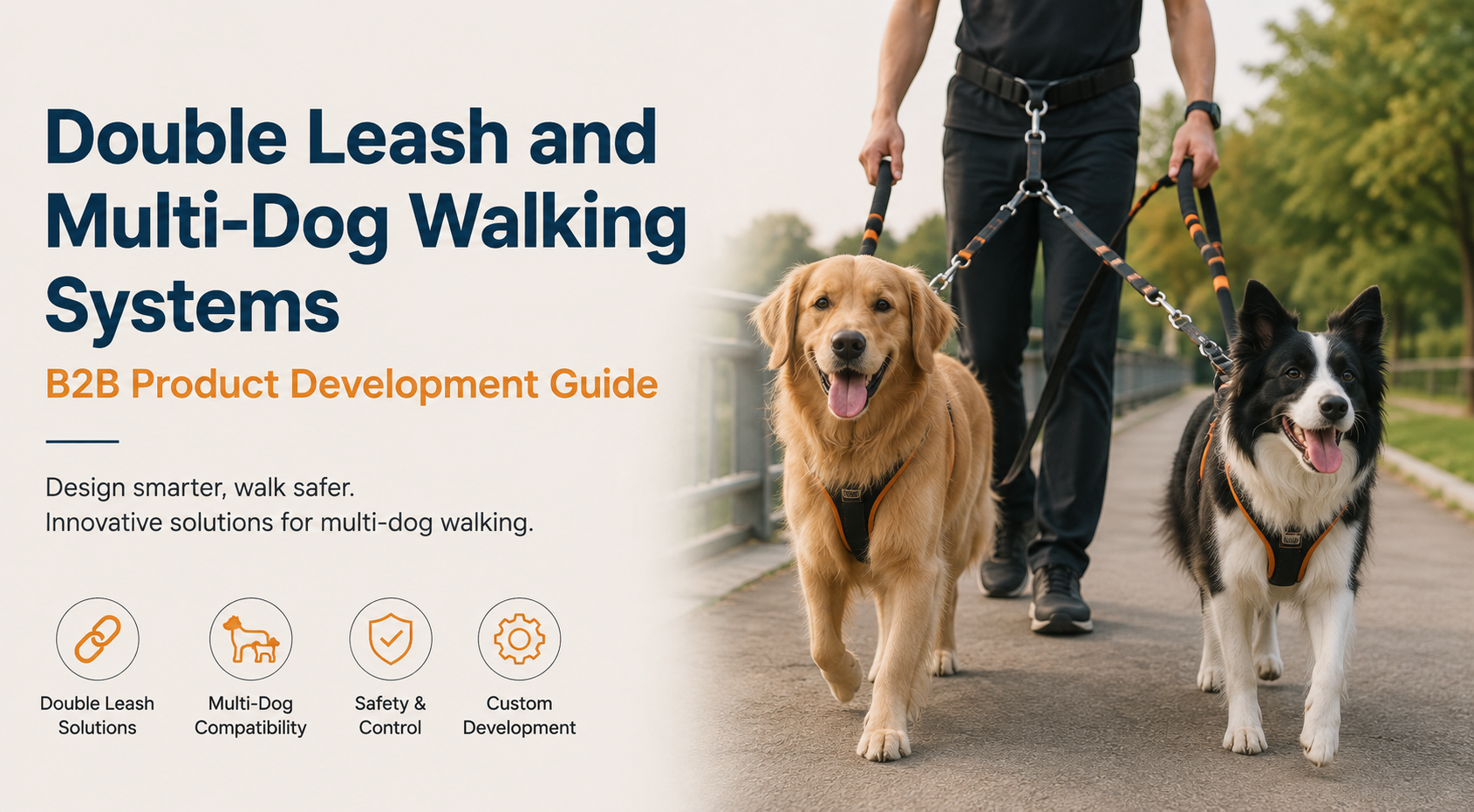
Famílias com vários cães representam um grupo demográfico crescente na posse de animais de estimação, impulsionado pela normalização dos animais de companhia como recursos de apoio emocional, the popularity of fostering and rescue operations, and the trend toward pet-inclusive household structures. Walking two or more dogs simultaneously presents handling challenges that single-leash systems do not address. The double leash, multi-lead coupler, and tandem walking system category has expanded from a utilitarian add-on into a product family with distinct engineering requirements, safety considerations, and market positioning strategies. For B2B buyers importing these products from China, understanding the mechanical, ergonomic, and behavioral engineering is necessary because this category carries elevated liability exposure alongside strong consumer demand and margin potential. Dongguan Coowone produtos ao ar livre Co., Ltda. fabrica multi-dog walking accessories and leash systems através do nosso pet collars and leashes production lines with load-rated hardware and tangle-resistant engineering.
Product Category Definitions
The terminology in this category is inconsistent across brands and markets. Clear category definition is necessary for specification accuracy.
Double Leashes
A single handle with two leash strands extending to two attachment points. Available as fixed-length double strands or with adjustable length differentiation between the two leads.
Couplers
A short Y-shaped connector that attaches to a single leash handle and splits into two clips for two dogs. The coupler itself is typically 30 para 60 cm in length, with the handler’s leash providing total length extension.
Tandem Leads
Longer lead systems that position two dogs in a sequential rather than parallel configuration. The first dog attaches at the lead termination; the second dog attaches at an intermediate point via a sliding or fixed ring.
Retractable Multi-Dog Systems
Dual-retractable housings that permit independent length management for each dog. These require significantly more complex engineering than standard retractable single-dog units.
Mechanical Engineering and Load Distribution
The fundamental challenge of any multi-dog system is managing the vector forces generated when two dogs pull in different directions simultaneously. This is not merely twice the load of a single dog—it is the vector sum of two potentially opposing forces, creating torque at the central junction that static single-leash design does not address.
Load at the Central Junction
When Dog A pulls left at 20 kgf and Dog B pulls right at 15 kgf, the central junction experiences lateral shear equivalent to the vector difference (5 kgf lateral) plus the vertical component from both dogs. If both dogs pull forward simultaneously, the junction experiences compression rather than tension. If both pull in opposite lateral directions, the junction experiences pure shear.
Swivel Engineering
The single most important component in a multi-dog system is the central swivel. Without effective rotation, the two leash strands cross, twist, and tangle with every directional change. Effective swivel design must provide:
- 360-degree rotation: Full free rotation under tension.
- Load rating: The swivel must sustain the combined dynamic load of both dogs without deformation or friction increase.
- Corrosion resistance: Saliva, mud, and water exposure degrade standard metal swivels. Marine-grade stainless steel or hard-anodized aluminum required.
- Anti-line-twist geometry: The leash attachment points should be positioned to prevent the two strands from wrapping around the central axis even during free rotation.
Shock Absorption and Jerk Management
Multi-dog systems amplify the impact of sudden lunges because the handler is managing two animals with one grip. Effective designs incorporate:
- Bungee segments in the individual leash strands, absorbing the initial impulse of a lunge before it reaches the handler’s arm.
- Load-limiter knots or stitching: Designed to yield slightly under overload conditions, preventing sudden full-force transmission.
- Padded handles: Wider handles (minimum 3 cm width) with silicone grip surfaces reduce hand fatigue and injury risk during extended walks.
Material Specifications for Multi-Dog Leashes
Leash Strands
- Nylon or polypropylene rope: 8 mm to 12 mm diameter, hollow-braid or kernmantle construction. Kernmantle (core-sheath) construction provides superior strength-to-weight ratio and better handling characteristics.
- Flat webbing: 20 mm to 25 mm width, suitable for couplers and shorter connector segments. Webbing offers less torsional stiffness than rope and is less likely to transmit twist to the central junction.
- Biothane or coated webbing: For wet-climate and working-dog applications. Provides waterproof handling and easy cleaning.
Handle Construction
- Double-handle designs: Some multi-dog leashes provide a secondary handle midway along the leash strands. This allows the handler to gather both dogs close to their body in high-traffic or high-distraction environments.
- Waist-belt conversion: Systems that convert from handheld to waist-worn configuration, distributing load to the handler’s hips rather than their hands.
- Traffic handles: Secondary close-proximity handles at the individual dog attachment points for immediate control without shortening the primary leash.
Hardware Specification
Central Junction Hardware
The junction between the handle/strand system and the individual dog leads is the highest-stress component.
- O-rings or figure-8 rings: Steel or aluminum rings that provide dual attachment points in a single structural element. Minimum wire diameter 6 mm for large-breed applications.
- Swivel bolt snaps: The individual dog clips must rotate freely. Swivel-eye bolt snaps are mandatory. Fixed-eye snaps guarantee tangle accumulation.
- Breakaway safety: Some designs incorporate breakaway mechanisms at the individual dog leads that release one dog if a severe entanglement or fight occurs, without releasing both simultaneously.
Individual Dog Clips
- Trigger snaps: Standard clip type. Spring-loaded gates that open under finger pressure.
- Locking carabiners: Higher-security clips that require a twist or squeeze to open, preventing accidental release during contact with vegetation or other dogs.
- Quick-link connectors: For working dogs and applications where accidental release is unacceptable. Require a tool to open, providing maximum security.
Tangle-Resistant Design
Tangle is the dominant consumer complaint in multi-dog walking categories. Effective engineering addresses tangle through both geometric and material strategies.
Geometric Strategies
- Fixed-length differentiation: If the two leash strands have different lengths (por exemplo, 120 cm and 150 cm), the dogs occupy different spatial zones, reducing the probability of crossing paths. The length difference must be calibrated to the dogs’ natural walking positions.
- Swivel-per-dog integration: Each individual strand should incorporate its own swivel in addition to the central swivel. Three total rotation points provide maximum anti-tangle capability.
- 360-degree free-rotation coupler bars: Some coupler designs use a rigid bar with attachment clips at either end, rather than a flexible Y-webbing. The bar provides lateral separation that webbing couplers do not.
Material Strategies
- Low-friction outer surface: Coated rope or webbing reduces friction when strands cross, permitting self-untangling rather than knot formation.
- Rigid spine segments: Short rigid sections near the central junction maintain separation between strands in the region where tangle is most likely to initiate.
Behavioral Considerations and Consumer Safety
Multi-dog systems are not appropriate for all dog-handler combinations. Product design and packaging must address the behavioral knowledge gap that leads to misuse.
Energy Level Matching
Two dogs with significantly different energy levels, prey drives, or training levels create management chaos on a double system. The higher-energy dog consistently overtakes, tangles, and redirects the lower-energy dog. Product sizing should specify weight ranges, but behavioral matching guidance should be included in documentation.
Fighting Risk
Dogs with existing inter-dog aggression should never be walked on a fixed coupler. A lunge by one dog transmits directly to the other through the rigid physical connection. Breakaway or quick-release individual components are essential for any multi-dog system intended for dogs with unknown social histories.
Handler Physical Limitation
Managing two dogs requires greater upper-body strength, reaction speed, and situational awareness than managing one. Elderly handlers, children, or handlers with mobility limitations should be directed toward tandem leads (sequential attachment) rather than parallel double leashes.
Regulatory and Liability Exposure
Multi-dog walking systems carry product liability exposure that single-leash products do not, because a system failure affects two animals and potentially two bystanders.
Warning Documentation Requirements
Appropriate warnings include:
- “Not for use with dogs exceeding combined weight of [X] kilograms.”
- “Not for use with dogs that exhibit aggression toward each other or other animals.”
- “Handler must possess physical capability to control combined force of two dogs.”
- “Inspect all hardware prior to each use for wear, corrosion, or deformation.”
Protocolo de teste
Multi-dog systems should be tested to failure using a test profile that replicates the most demanding load case: two test masses pulling in opposite directions simultaneously, each mass representing the maximum rated dog weight. The system must survive 60 seconds at 3x rated load per dog without hardware deformation or connection failure.
Variant Configurations and Market Positioning
Adjustable Length Couplers
Couplers with triglide or cam-lock adjustment at the individual strands, allowing the handler to equalize or differentiate the reach of each dog in real time. Popular for handlers managing dogs of different sizes.
Reflective and Visibility Systems
Multi-dog walking often occurs at dawn or dusk when owners walk dogs before or after work. Reflective strand weaving, LED clip attachment points, and reflective handles improve safety in reduced-light conditions.
Hands-Free Multi-Dog Systems
Waist-belt configurations that permit the handler to walk two dogs while carrying items, pushing strollers, or using trekking poles. The waist-belt must be wide (minimum 8 cm) and padded to distribute the combined dog load across the pelvis without creating pressure points.
Running-Specific Multi-Leads
For handlers who jog or run with two dogs. Features include:
- Bungee shock absorption rated at the higher impulse forces generated during running.
- Waist-belt configuration with lumbar pad to absorb rhythmic stride motion.
- Reflective striping or LED integration for road-running visibility.
- Hands-free grip for forward momentum, reducing arm strain over distance.
Training and Service Applications
Professional dog walkers, pet sitters, and service dog handlers require multi-dog systems with enhanced durability and component replaceability:
- Replaceable strand segments: Individual strands should be field-replaceable without replacing the entire system.
- Modular handle configurations: Convertible between handheld, waist-worn, and shoulder-strap modes.
- High-visibility materials for professional identification and traffic safety.
Sizing and Fit Engineering
Multi-dog systems must accommodate pairs with significant size differences. A system designed for two 10-kg dogs will not safely manage a pair consisting of a 15-kg dog and a 30-kg dog.
Size Range Architecture
Manufacturing programs should offer:
- Small-system: Combined dog weight up to 20 kg.
- Medium-system: Combined dog weight 20 para 40 kg.
- Large-system: Combined dog weight 40 para 70 kg.
- XL-system: Combined dog weight over 70 kg.
Individual strand rating should equal or exceed the maximum single-dog weight in the category, not the average. If a large-system handles two dogs totaling 60 kg, each strand must be rated for 40 kg independently.
Wholesale Economics
Factory cost benchmarks (1,000-piece MOQ):
- Basic webbing coupler: $1.50 para $3.00.
- Nylon rope double leash with swivel: $3.50 para $6.00.
- Reflective double leash with bungee segments: $5.50 para $9.00.
- Hands-free waist-belt multi-dog system: $7.00 para $14.00.
- Professional-grade modular system with replaceable components: $12.00 para $25.00.
Preços de varejo:
- Basic couplers: $10 para $18.
- Standard double leashes: $20 para $35.
- Reflective/active models: $30 para $55.
- Professional modular systems: $55 para $120.
The margin structure supports wholesale distribution at 2.0x to 2.5x landed cost.
No Dongguan Coowone produtos ao ar livre Co., Ltda., nosso leash and multi-dog walking system manufacturing encompasses coleiras, coleiras, and connector products with load-rated hardware and tangle-resistant engineering. Nosso 10+ years of production experience includes programs for North American and European multi-dog system brands with documentation and batch testing for custom pet accessories.
Conclusão
Double leash and multi-dog walking systems represent a technically demanding category where mechanical engineering, behavioral awareness, and liability management intersect. The products that succeed in this category combine robust load-rated hardware, effective swivel engineering, tangle-resistant geometry, and responsible consumer education. The category has proven resistant to commoditization because the engineering complexity creates natural barriers to low-cost competition, while the behavioral knowledge required for safe use makes brand trust a meaningful purchasing factor.
For B2B buyers seeking OEM or private-label manufacturing para multi-dog walking systems with load testing documentation, hardware certification, and tangle-resistant design validation, Dongguan Coowone produtos ao ar livre Co., Ltda. fornece engineered production capability entre pet collars and leashes linhas. Contact our product engineering team to discuss multi-dog system specifications, safety testing protocols, and market-specific packaging for your walking product program.