


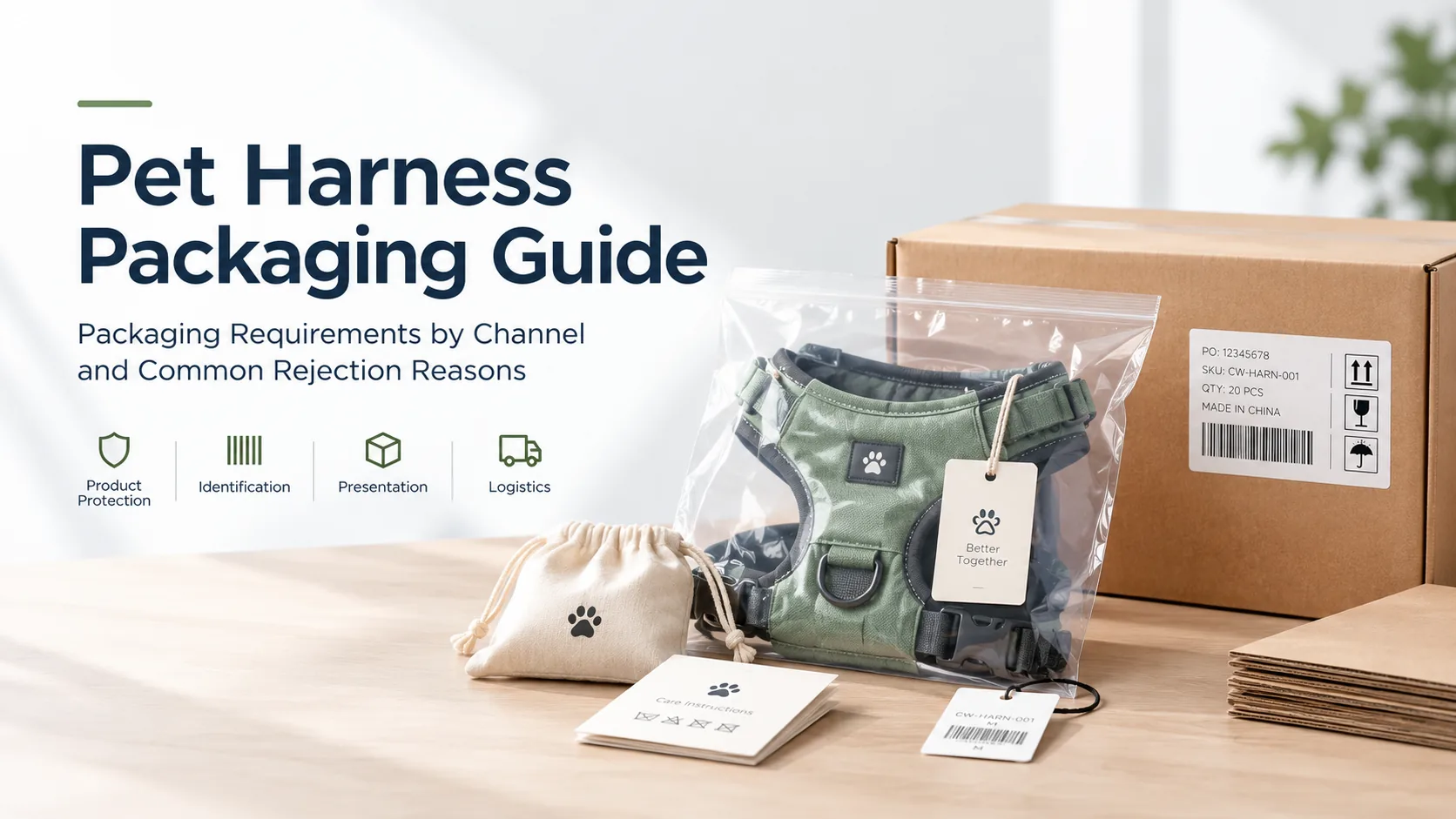
询问工厂如何包装线束,您通常会得到一份清单: 塑料袋, 盒子, 吊牌, maybe a fabric pouch. All of those exist. None of them is a specification, and none of them tells you whether the thing you ordered will be accepted by the channel you plan to sell through.
That is the gap worth closing early, because packaging is the last step before your deposit turns into revenue — and the point at which a mistake is most expensive to fix. A wrong print is a delay. A carton that fails at the fulfilment centre is a whole shipment sitting in a holding bay, reworked at your cost, with the launch date you already announced.
This article is the specification, channel by channel, with the numbers that actually get shipments rejected.
The four layers most brands conflate
Packaging decisions get muddled because people treat “包装” as one thing. It is four, and they are specified separately, priced separately and can fail separately.
| Layer | What it is | What it decides |
|---|---|---|
| 1. Unit protection | Poly bag, 裹, tissue, or none | Whether the product arrives clean and undamaged |
| 2. Unit identification | Barcode, FNSKU, hangtag, care label | Whether the unit can be scanned, sold and legally offered |
| 3. Unit presentation | Printed bag, 盒子, sleeve, belly band | Whether it looks like your brand on a shelf or in an unboxing |
| 4. Outer logistics | Master carton, carton mark, pallet | Whether the shipment is accepted and where it can be stored |
A factory that quotes “packaging included” without telling you which of these four are covered is not giving you a price. It is giving you a number you will discover the meaning of later.
Layer 1: unit protection
For soft goods like harnesses, 项圈和皮带, the default is a poly bag. The specification points that matter:
厚度. Marketplace rules commonly require1.5 mil (关于 38 µm) 最低限度 for poly bags, with heavier items needing 2 mil. Below that, bags split in transit and the product arrives scuffed. This is a number your supplier should be able to state without looking it up.
Suffocation warning. Any poly bag with an opening of5 inches (12.7 厘米) or more needs a suffocation warning printed on the bag or applied as a permanent label. This is a legal safety requirement in the US, not a marketplace preference, and it is one of the most common reasons shipments are rejected outright.
Transparency and seal. Bags must be transparent or translucent, fully sealed, and the barcode must remain readable through the bag. Excess material should be trimmed — a bag vastly larger than the product reads as careless and inflates cube.
When not to use a bag. At the premium end, a fabric pouch or a printed box replaces the poly bag entirely. That is a presentation decision with a protection consequence: a box protects better than a bag against compression and worse against moisture. If your route to market involves sea freight and a humid container, plan for both.
Layer 2: unit identification — the part that gets shipments rejected
This is where most first orders fail, and it fails silently until the carton reaches a warehouse.
条形码
You need one scannable barcode per unit. Which one depends on the channel:
| 渠道 | Identifier | 笔记 |
|---|---|---|
| 自有网店 | Internal SKU; a printed barcode is optional but useful for stocktaking | You control the format |
| 独立精品店 | UPC (US/Canada) 或者EAN (欧盟) | Buying a legitimate GS1 prefix is not optional; resold prefixes are a liability |
| 亚马逊 | FNSKU | Must cover any existing UPC/EAN — only one barcode may be scannable |
| Retail chains | Usually their own vendor requirements | Ask for the vendor pack before you print anything |
Two rules that cause the most rejections: only one scannable barcode per unit, 和never place a barcode on a curved or seamed surface. If your packaging is a printed box, the barcode goes on a flat panel, away from edges, at least a quarter inch clear of any fold.
Hangtags and care labels
A hangtag is the cheapest piece of brand real estate you will ever buy, and it is also where compliance content usually lives. At minimum it should carry the product name, 尺寸, material composition and care instructions. Care labelling requirements vary by market — the US and EU both require fibre content and origin information on textile products, and the exact wording is jurisdiction-specific. Confirm the current requirement for your market rather than copying a competitor’s tag.
Country of origin
“Made in China” must appear on the unit for US customs purposes. It is not an Amazon rule, but Amazon audits for it, and a missing origin mark is a listing-suspension risk. For the EU, the importer’s name and address must appear on the product or its packaging.
Layer 3: unit presentation — what the channel expects
Presentation is where brands overspend and under-deliver, usually by commissioning a beautiful box that does not survive the channel.
| Format | 最适合 | 留意 |
|---|---|---|
| Printed poly bag with header card | 亚马逊, 市场, entry price points | Looks cheap in a boutique; header card adds a separate print run |
| Kraft or printed box | DTC unboxing, 送礼, higher price points | Compression damage; dimensional weight charges if oversized |
| Belly band or sleeve | Boutiques, 送礼, low tooling cost | Does not protect on its own — usually wraps a bag or a folded product |
| Fabric or reusable pouch | 高端定位, gift-with-purchase | Cost per unit is high; still needs a barcode and care label |
| None (hangtag only) | Boutique peg display | No protection at all in transit; only works with a separate master-carton solution |
One practical constraint that is easy to miss: printed packaging has its own minimum order quantity, separate from the product’s. A 20-piece-per-design-per-size product run can easily sit behind a 500- or 1,000-piece packaging minimum. If your first order is small, printed bags and boxes may be the expensive part — a plain bag with a well-designed hangtag is often the better first move, and it can be upgraded on the second order once the product has proven itself.
Layer 4: outer logistics
The master carton is where the cheapest mistakes happen, because nobody looks at it until it is too late.
| Requirement | Typical limit | Consequence of getting it wrong |
|---|---|---|
| Carton weight | 50 lb / 23 千克 maximum for standard handling | Above that, “Team Lift” labelling is required; failures are a safety violation |
| Carton dimensions | Varies by channel; oversized cartons attract dimensional weight charges | You pay for air |
| Carton mark | Ship-to, shipment ID barcode, carton count | Missing or unscannable labels cause the carton to be refused |
| Label placement | On a side panel, clear of seams and edges, not taped over | A label over the opening flap gets sliced open on receipt |
| Single-SKU cartons | Preferred where the channel allows | Mixed cartons slow receiving and invite counting errors |
| Pallet labels (if palletised) | On all four sides, outside the stretch wrap | Unlabelled pallets get held |
One detail worth more attention than it gets: thermal label durability. A container from southern China to the US Gulf in summer can exceed 50°C internally. Cheap thermal paper fades, and a faded label arrives as a blank box. If your supplier is printing labels, specify top-coated heat-resistant stock.
The packaging specification sheet
This is what to send your factory alongside the product specification. It is short, and it prevents almost every problem described above.
| 场地 | Your answer |
|---|---|
| 渠道(s) | Webstore / marketplace / 精品店 / chain |
| Unit protection | Poly bag (thickness) / 盒子 (材料, dimensions) / 裹 / none |
| Suffocation warning | Required / not required — state which, based on opening size |
| Barcode type and placement | UPC / EAN / FNSKU; which panel, which orientation |
| Existing barcodes to cover | 是的 / no |
| 吊牌 | Dimensions, 材料, printed content, string or loop type |
| Care label | Content required by market; sewn-in or printed |
| Country of origin mark | Where it appears |
| Packaging print run | Quantity, and whether it is a separate minimum |
| Master carton | Units per carton, max weight, carton mark content |
| Labelling by whom | Factory / your 3PL / prep centre |
| Sample packaging | Request a packed sample, not just the product |
That last row is the one people skip.Ask for a packed sample. A product sample tells you whether the harness is right. A packed sample tells you whether the bag is the right size, whether the tag hangs straight, whether the barcode sits on a flat panel and whether the carton will stack. It costs one more shipping slot and saves an entire rework cycle.
常问问题
What poly bag thickness do I need for pet products?
Marketplace rules commonly require 1.5 mil (关于 38 µm) 最低限度, 和 2 mil for heavier items. For soft goods like harnesses and leashes, 1.5 mil is normally sufficient — the failure mode is not the product weight but the bag splitting on a carton edge, so bag sizing matters as much as thickness.
Do I need a suffocation warning on every poly bag?
No — the requirement attaches to bags with an opening of 5 inches (12.7 厘米) or more. In practice that covers almost every bag large enough to hold a harness, so treat it as required unless you have confirmed otherwise.
Can my factory print my barcode for me?
Many can, and it is usually the right call for a first order because it keeps barcode and packaging in one place. What you must not delegate is the number itself: a UPC or EAN should come from a GS1 prefix registered to your company, not a resold code.
What is the difference between a hangtag and a care label?
A hangtag is attached for sale and usually removed by the customer; it carries branding, size and marketing content. A care label is permanently attached and carries legally required fibre, origin and care information. They are not interchangeable, and a hangtag with care instructions printed on it does not satisfy a care-labelling requirement.
Why did my shipment get rejected for packaging?
The three most common causes are a missing suffocation warning, a non-scannable or duplicated barcode, and a carton that is over the weight limit or missing its carton mark. All three are specification failures, which means all three are preventable before production rather than fixable after it.
Is sustainable packaging worth the cost?
It depends on your customer and your channel. Recycled and recyclable materials are now a genuine differentiator in DTC and boutique, and a liability in discount channels where cost dominates. The practical middle is to reduce material rather than change it: right-sized bags, fewer print layers and cartons that fit the product properly save money and reduce waste at the same time.
Specify the packaging at the same time as the product
Packaging is not the last decision in a production run. It is the decision that determines whether the run can be sold, and it is cheapest to make while the product specification is still open.
COOWONE quotes product and packaging together — poly bag, hangtag, care label, barcode placement and master carton — so the price you approve is the landed, sellable unit, not a product that still needs finishing.
Send us your channel and your product spec, and we will quote the packaging with it →https://coowone.com/contact/
参考
- Amazon FBA prep and polybag requirements — bag transparency, minimum thickness (1.5 mil, 或者 2 mil for heavier items), full sealing, barcode readability, and the suffocation warning threshold for bags with a 5-inch (12.7 厘米) or larger opening. Summarised across published seller guidance; confirm against Amazon Seller Central for your marketplace, as requirements change.
- Amazon FBA labelling requirements — one scannable barcode per unit, FNSKU must cover the existing UPC/EAN, 最低限度 300 DPI thermal printing, label placement clear of edges and seams, carton weight limit of 50 lb (22.6 千克) with Team Lift labelling above that, and carton-label placement on a side panel away from the opening flap.
- US Customs requirements — country of origin marking (“Made in China”) on units imported to the United States. EU requirements — importer name and address on the product or packaging, plus CE marking where the product category requires it.
- General retail packaging cost and specification guidance for pet products, including the effect of standardising box sizes, print-colour count and pack-size optimisation on unit cost. Indicative only; obtain your own quotes.