
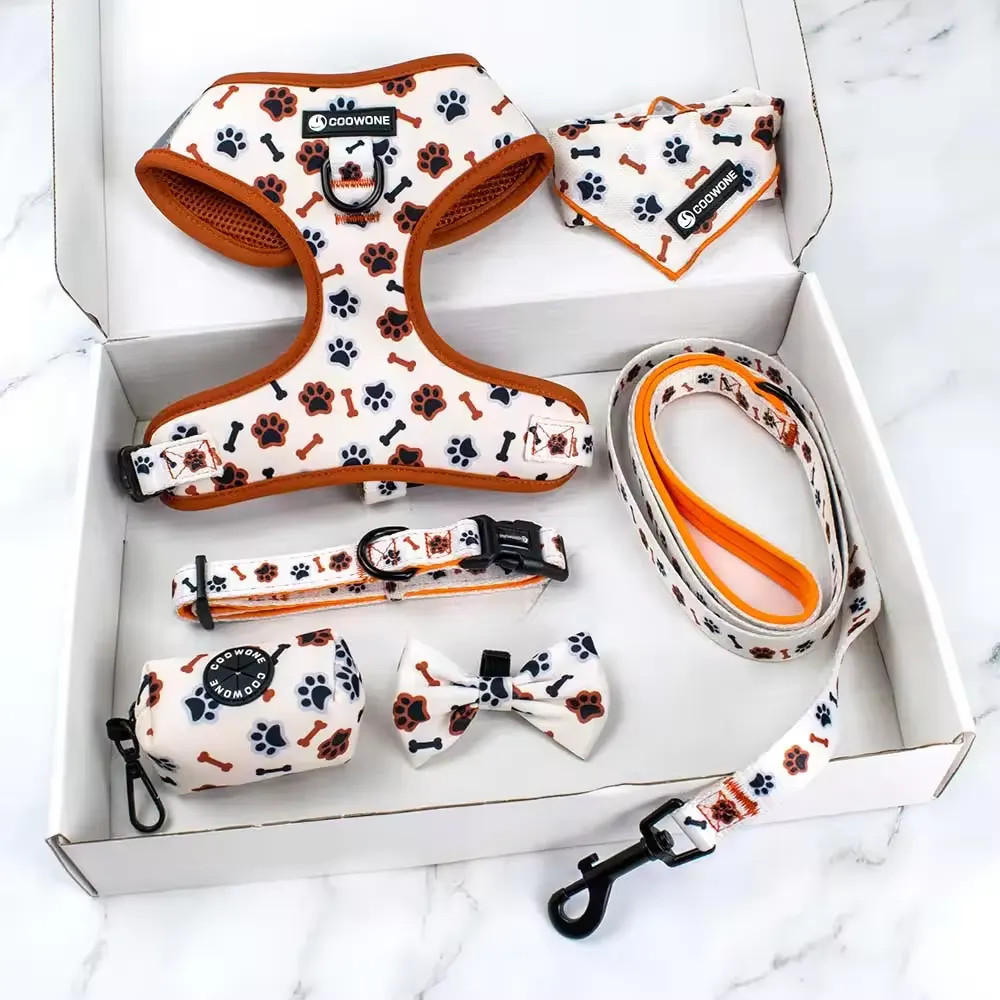

线束入口几何形状的基本问题(步入式与头顶式)更多地决定了线束的制造复杂性, 消费者可用性, 适合安全, and return rate than many buyers assume. What appears to be a simple design preference actually represents divergent pattern engineering philosophies, material consumption profiles, hardware requirements, and fit-system constraints. For B2B buyers sourcing dog harnesses from factories in China, understanding these construction differences is necessary for accurate costing, specification communication, quality expectation setting, and return-rate prediction. 东莞市酷旺户外用品有限公司, 有限公司. 制成品 both step-in and overhead harness configurations 通过我们的 狗背带套装 production lines with validated pattern libraries for both entry systems.
The Structural Logic of Harness Entry Geometry
Dog harnesses must accomplish two physical tasks: surround the dog’s torso securely, and connect the handler to the dog through an attachment point. The entry geometry defines how the harness achieves the first task. The two dominant approaches represent different compromises between ease of use, fit precision, material efficiency, and escape resistance.
Step-In Harness Construction
In a step-in design, the dog places its front legs into two pre-formed loops. The handler then brings a dorsal strap or panel across the dog’s back and secures it with a buckle or clip. The harness tension is applied primarily across the chest and belly, with the back strap serving as the structural connector.
Over-Head Harness Construction
In an overhead design, the dog’s head passes through a neck opening. The harness then drops into position around the shoulders and chest. A belly strap or girth strap secures the harness around the torso. The neck opening and chest panel provide primary structure, with the belly strap functioning as the securing mechanism.
Pattern Engineering and Material Consumption
The pattern complexity difference between step-in and overhead harnesses is significant and directly impacts factory cost.
Step-In Pattern Characteristics
- Dual leg openings: The front panel must provide two distinctly shaped apertures—leg holes—while maintaining structural continuity across the sternum between them. This requires either a single piece of material with precise cutouts or a multi-panel assembly with seam reinforcement at the intersection points.
- X-strap or H-strap variants: Step-in harnesses use either crossing straps that form an X across the back or parallel straps that form an H. X-strap designs distribute load more evenly but require four-point adjustment. H-strap designs simplify adjustment to two points but concentrate loading at the crossing junction.
- Chest bridge: The material segment between leg openings is the most structurally critical and most wear-prone area of a step-in harness. This segment sustains the full leash load and must resist tearing under dogs that pull aggressively.
- Material yield: The dual-leg-cutout pattern generates more scrap material than a continuous neck-hole pattern. Step-in harnesses consume 15% 到 25% more fabric per unit than overhead harnesses of equivalent size, assuming both use the same material width.
Over-Head Pattern Characteristics
- Continuous neck panel: The neck opening is cut as a U-shaped or V-shaped notch in a continuous panel. This is material-efficient and structurally simple to pattern.
- Single belly strap: Most overhead designs secure with one or two belly straps that wrap beneath the torso. These straps are straight-cut webbing, the simplest component in harness manufacturing.
- Variable neck opening geometry: The neck opening must accommodate the largest circumference that passes through it (the skull) while fitting snugly at the narrowest point where it rests (the neck). This dimensional gap creates a fit engineering challenge that step-in harnesses do not face.
Fit System and Adjustment Complexity
The number of adjustment points determines both the fit precision and the manufacturing cost of a harness, because each adjustment point requires hardware (triglide slides), webbing extension, and quality verification.
Step-In Adjustment Architecture
Standard step-in harnesses require two to four adjustment points:
- Two points at the leg openings to set chest width.
- One or two points at the back strap crossing to set torso length.
Because the chest bridge length is fixed by pattern, a step-in harness cannot accommodate dogs with chest depths significantly outside the target range. A step-in harness designed for a deep-chested breed (Greyhound) will fit poorly on a barrel-chested breed (Bulldog) even if nominal size categories overlap. This creates elevated return rates for online retailers selling step-in harnesses without breed-specific sizing guidance.
Over-Head Adjustment Architecture
Standard overhead harnesses require one to three adjustment points:
- One point at the neck opening.
- One or two points at the belly strap.
- Optional dual chest strap designs add one further adjustment.
The neck-belly two-point system provides more dimensional flexibility than step-in designs because it decouples neck fit from chest fit. An overhead harness can accommodate a dog with a thick neck and narrow chest (Mastiff conformation) or a narrow neck and deep chest (Sighthound conformation) through independent strap adjustment. This dimensional flexibility reduces return rates in generalist retail where consumers purchase without breed-specific sizing knowledge.
Hardware Requirements and Cost Implications
Hardware consumption is one of the most direct cost drivers in harness manufacturing.
Step-In Hardware Profile
- Minimum two strap clips or buckles for the dorsal closure.
- Two to four triglide adjustment slides.
- One leash attachment D-ring or V-ring.
- If the harness includes a handle, additional hardware for handle attachment.
- Average hardware count: 6 到 9 件.
Over-Head Hardware Profile
- One or two strap clips/buckles for belly closure.
- One to three triglide adjustment slides.
- One leash attachment D-ring.
- Average hardware count: 3 到 6 件.
At typical hardware costs of $0.08 到 $0.25 per piece depending on specification, the hardware differential alone contributes $0.40 到 $0.75 per unit to the step-in overhead cost premium.
Escape Resistance: The Critical Performance Difference
One of the most important consumer satisfaction metrics for dog harnesses is escape resistance. The harness must hold the dog securely when the dog attempts to reverse out, twist free, or compress their body to slip through openings.
Step-In Escape Vulnerability
The primary escape route in a step-in harness is backward: the dog pulls a rear leg through the leg opening, followed by twisting the body to release the second leg. If the back strap is not tightened sufficiently, this escape maneuver succeeds with minimal effort.
Countermeasures in design:
- Low-set back strap: Positioning the dorsal closure low on the back, near the shoulder blades rather than mid-back, reduces the leverage the dog has to twist free.
- Elasticized belly bands: Adding elastic tension to the belly circumference maintains constant soft pressure even as the dog attempts to compress their torso.
- Chest bridge reinforcement: A reinforced sternum panel resists the compression that precedes a backward escape attempt.
Over-Head Escape Vulnerability
The primary escape route in an overhead harness is downward and backward: the dog lowers their head, tucks their chin, and pulls backward through the neck opening. If the neck strap is not properly tensioned at the correct position (high on the neck, behind the ears, not low on the shoulders), this escape succeeds.
Countermeasures in design:
- Martingale function at neck: A limited-slip mechanism that allows the neck opening to contract under reverse pressure, preventing the dog from pulling their head through.
- Chest fit precision: A front panel that wraps securely around the chest prevents the dog from rotating the harness 180 degrees to access the neck opening.
- Dual belly straps: Adding a second belly strap behind the ribcage distributes security across the torso, reducing the opportunity for compress-and-escape.
Independent testing data suggests that properly fitted overhead harnesses with martingale neck functions have marginally lower escape success rates (在下面 5% in controlled testing) than properly fitted step-in harnesses (8% 到 12%) when tested with determined escape artists. 然而, badly fitted overhead harnesses fail at dramatically higher rates (30%+) because the neck opening creates a single obvious escape route.
Consumer Usability and Return Drivers
Fit trouble and escape incidents are the two dominant return drivers for dog harnesses. Understanding construction differences helps buyers predict and mitigate these drivers.
Step-In Usability Profile
- 优点: Intuitive for dogs that dislike overhead handling or have anxiety about objects around their head. Ideal for brachycephalic breeds with large skulls relative to neck circumference (斗牛犬, 哈巴狗, 波士顿梗犬) where overhead donning is genuinely difficult.
- Disadvantages: Requires the dog to cooperate with leg placement. Some dogs resist placing their feet into loops. The handler must reach beneath the chest to secure the back strap—a maneuver that can trigger defensive responses in anxious dogs.
Over-Head Usability Profile
- 优点: Fast donning for cooperative dogs. Most dogs learn the overhead routine quickly because it mirrors collar placement. Single-buckle closure at the belly is fast and simple.
- Disadvantages: Requires the dog to accept the neck opening passing over their face. Difficult or impossible for dogs with larger skull circumferences relative to neck measurements. If the neck fit is not precise, the entire harness security fails.
Manufacturing Quality Control Differences
Step-In QC Priorities
- Leg hole reinforcement: The intersection seams at the leg openings are the most stressed seams in the harness. Bar-tack reinforcement and seam-bonding verification are essential.
- Chest bridge symmetry: The harness must have bilateral symmetry in leg opening placement. Asymmetry of more than 5 mm causes gait interference and chafing.
- Closure alignment: When the back straps are crossed and clipped, the attachment points must align precisely. Misaligned clips create torque that migrates the harness during walking.
Over-Head QC Priorities
- Neck opening circumference accuracy: The neck opening must match specification within ±5 mm. Too large permits escape; too small prevents donning.
- Belly strap length calibration: The belly strap must provide full closure at the smallest end of the size range with at least 5 cm of overlap at the largest end. Insufficient overlap range creates fit failures.
- Chest panel positioning: The chest panel must sit at the sternum, not at the abdominal soft tissue. Construction that drops the chest panel too low creates fit failure and potential respiratory restriction.
Size Range and Scaling Strategy
Step-in harnesses require more distinct size molds because the fixed chest bridge limits adjustment range. A typical step-in harness line requires five to six sizes to cover the same breed range that an overhead harness line covers with four sizes.
This has two business implications:
- Inventory complexity: More SKUs increase working capital requirements and inventory risk.
- Fit precision per SKU: Narrower size ranges per SKU mean better average fit, potentially reducing returns at the cost of inventory complexity.
Over-head harnesses, with their more flexible fit systems, can achieve broad breed coverage with fewer SKUs. This reduces inventory overhead but may increase returns if consumers miscalibrate fit.
Construction Variants Within Each Category
Step-In Subtypes
- Roman harness: Features a chest bridge with two parallel belly straps forming an H. Provides good load distribution but requires more material and hardware.
- Western/curved harness: Features a curved chest panel that wraps around the sternum. Improves fit for deep-chested breeds.
- Vest-style step-in: Combines step-in leg openings with a broader vest panel across the back. Adds material cost but improves partner visibility for working dogs and fashion positioning.
Over-Head Subtypes
- Standard H-back: Neck panel plus single belly strap. Simplest construction, lowest cost.
- Dual-clip harness: Neck panel plus chest strap and belly strap, with attachment points at both chest and back. Provides steering ability and anti-pull function.
- Harness-vest hybrid: Neck entry with broad back and side panels. Popular for cold-weather positioning, reflective systems, and service dog patches.
Hybrid Configurations
Some advanced harnesses combine elements of both entry systems: side-release closures that function as step-in openings but with a soft neck panel that wraps around rather than requiring overhead passage. These configurations attempt to capture the advantages of both systems but at higher manufacturing complexity.
在 东莞市酷旺户外用品有限公司, 有限公司., 我们的 pattern engineering department maintains validated specifications for both step-in and over-head harness architectures 跨越我们的 狗背带套装 和 collar and leash product lines. 我们的 10+ years of manufacturing experience includes production runs for brands requiring precise fit systems across both entry geometries with documented escape-resistance testing.
Pricing and Factory Cost Benchmarks
Given equivalent material grade and hardware specification:
- Basic step-in harness: $4.50 到 $8.50 每单位.
- Basic overhead harness: $3.50 到 $7.00 每单位.
- Premium step-in with reinforced chest bridge and four-point adjustment: $8 到 $14 每单位.
- Premium overhead with martingale neck and dual-clip configuration: $7 到 $12 每单位.
这 20% 到 30% step-in cost premium reflects higher material consumption, greater hardware count, and more complex pattern assembly.
零售定价:
- Standard step-in: $25 到 $45.
- Standard overhead: $20 到 $40.
- Premium variants: $40 到 $75+.
Product Line Strategy for B2B Buyers
Buyers should not view this as a binary choice. Successful pet product lines typically include both configurations to serve different consumer needs and dog behavioral profiles.
Recommended Portfolio Architecture
- Entry-level overhead harness: Lowest cost, simplest construction, broadest fit range. Volume driver.
- Mid-tier dual-clip harness: Anti-pull functionality, dual attachment points, overhead entry. Margin driver.
- Premium step-in harness: Specialized fit for brachycephalic breeds, head-shy dogs, and fashion positioning. Differentiation driver.
- Hybrid/vest configurations: Service dog, cold-weather, or reflective premium positioning.
结论
The step-in versus overhead harness decision is not a matter of aesthetic preference. It is a manufacturing specification, 成本结构, fit-system, and return-rate determination that should be made with full understanding of pattern engineering, hardware implications, and consumer usage patterns. Buyers who select construction geometry based solely on visual appeal or trend following will encounter the fit failures, 退货率, and negative reviews that erode brand credibility and margin. Buyers who approach the choice with engineering awareness and portfolio balance build product lines that serve the full spectrum of dog conformation and owner handling preferences.
对于寻求的买家 OEM manufacturing programs 为了 介入, overhead, or hybrid harness configurations, 东莞市酷旺户外用品有限公司, 有限公司. 提供 pattern engineering, fit-panel validation, and quality-controlled production 穿过 狗背带 和 custom pet accessory 线. Contact our product development team for specification review, fit-system engineering, and costing analysis for your harness construction strategy.